If you’ve never completed a First Aid course before, you might be wondering what to expect. Will there be an exam? Do you need previous experience? Will you have to perform CPR in front of others?
The good news is that First Aid training is designed to be practical, engaging and suitable for people from all backgrounds. Whether you’re completing training for work, volunteering, a sporting club or simply to gain valuable life-saving skills, you’ll learn how to confidently respond to a wide range of medical emergencies.
At Accidental Education, we believe First Aid training should prepare people for real emergencies—not just help them pass an assessment. Our courses combine nationally recognised training with realistic practical scenarios to build confidence and competence.
Here’s what you can expect during a typical First Aid course.
Before the Course
Depending on the qualification, you may be asked to complete some online learning before attending the practical session.
This pre-course learning introduces important topics such as:
- The role of a first aider
- Workplace health and safety
- Emergency response principles
- Casualty assessment
- Basic anatomy
- Infection prevention
- First aid procedures
Completing this learning beforehand allows more time to focus on practical skills during the face-to-face session.
Learning the DRSABCD Action Plan
One of the first practical concepts you’ll learn is the DRSABCD Action Plan, which provides a simple framework for responding to emergencies.
Participants learn how to:
- Check for danger
- Assess the casualty’s response
- Call for help
- Open the airway
- Check breathing
- Perform CPR
- Use an Automated External Defibrillator (AED)
This structured approach helps responders remain calm and organised during stressful situations.
CPR Training
CPR is one of the most important skills covered during every First Aid course.
Participants receive hands-on instruction in:
- Adult CPR
- Child CPR
- Infant CPR
- Compression technique
- Compression depth
- Compression rate
- Rescue breaths
- Team CPR
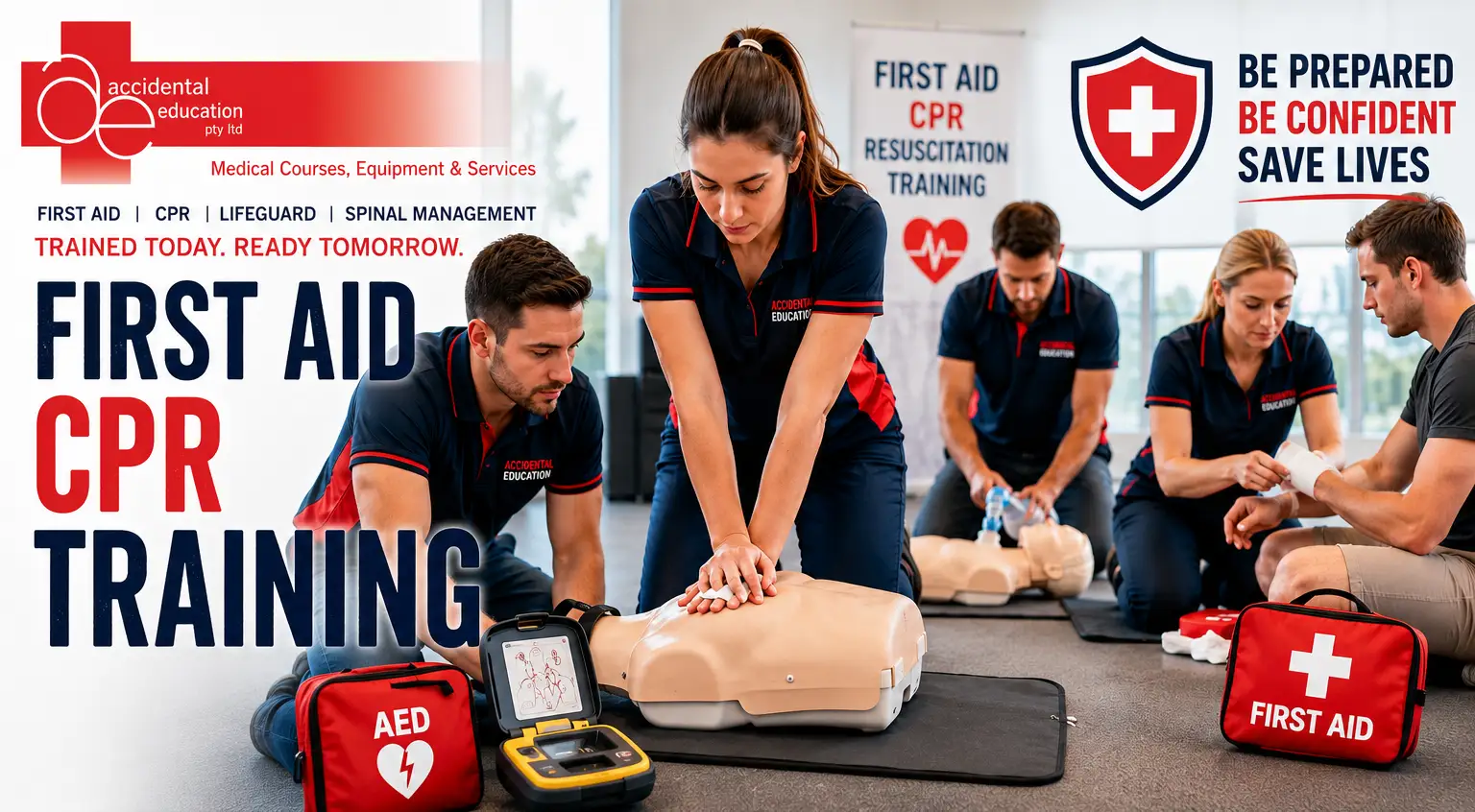
Every participant practises these skills on professional CPR manikins under instructor supervision.
Learning to Use an AED
Modern workplaces, schools, sporting clubs and public facilities increasingly have Automated External Defibrillators (AEDs) installed.
During the course you’ll learn:
- When to use an AED
- How to operate the device safely
- Correct pad placement
- Following voice prompts
- Safety checks
- Team communication during resuscitation
Many participants are surprised at how simple modern AEDs are to use once they receive practical instruction.
Managing Common Medical Emergencies
A comprehensive First Aid course prepares participants to manage many different emergencies.
Topics commonly include:
- Severe bleeding
- Burns
- Fractures
- Soft tissue injuries
- Head injuries
- Eye injuries
- Choking
- Asthma
- Anaphylaxis
- Heart attack
- Stroke
- Seizures
- Diabetes
- Shock
- Unconscious casualties
The emphasis is on recognising emergencies quickly and providing appropriate care until professional medical help arrives.
Practical Scenarios
One of the most valuable parts of any First Aid course is the practical training.
Rather than simply listening to presentations, participants work through realistic emergency scenarios.
These may include:
- A workplace accident
- A person collapsing from cardiac arrest
- A choking casualty
- A severe bleeding incident
- An asthma emergency
- An allergic reaction
- A sporting injury
- A fall resulting in fractures
- An unconscious patient
Working through these scenarios helps build confidence and prepares participants for real-life emergencies.
Learning Through Teamwork
Emergency response is rarely a one-person task.
Throughout the course you’ll work alongside other participants to practise:
- Communication
- Delegating tasks
- Calling Triple Zero (000)
- Performing CPR as a team
- Using an AED together
- Managing bystanders
- Handover to emergency services
These teamwork exercises reflect how emergencies are managed in real workplaces.
Practical Assessment
Nationally recognised First Aid courses include practical assessments.
These assessments are designed to confirm that participants can safely perform essential first aid skills.
Assessment activities may include:
- CPR performance
- AED operation
- Casualty assessment
- Managing simulated emergencies
- Recovery position
- Bandaging techniques
- Responding to common medical conditions
The assessment is supportive rather than intimidating, and instructors provide guidance throughout the course.
Do You Need Previous Experience?
Not at all.
First Aid courses are designed for beginners as well as those renewing their qualifications.
Many participants attend with no previous medical experience.
Our instructors explain every procedure clearly and guide participants through practical exercises step by step.
What Should You Bring?
For most courses, everything you need is supplied.
We recommend bringing:
- Photo identification (if required)
- Comfortable clothing
- Closed-in shoes
- Water bottle
- Notebook (optional)
Most importantly, bring a willingness to participate in practical activities.
Why Practical Training Matters
Reading about First Aid is valuable, but confidence comes from doing.
Hands-on training allows participants to:
- Practise repeatedly
- Build muscle memory
- Improve communication
- Gain instructor feedback
- Develop confidence
- Learn from realistic scenarios
These practical experiences prepare participants to respond effectively when emergencies happen.
Why Choose Accidental Education?
At Accidental Education, we specialise in practical emergency response training that prepares participants for real-world situations.
We work with organisations throughout New South Wales, delivering nationally recognised training through our partnering Registered Training Organisation (RTO #40833).
Our services include:
- First Aid Training
- CPR Training
- Advanced First Aid
- Advanced Resuscitation & Oxygen Therapy
- Workplace AED Training
- Spinal Management
- Pool Lifeguard Training
- Green Whistle (Methoxyflurane) Administration Training
- Annual refresher courses
We regularly deliver training for:
- Businesses
- Local councils
- Schools
- Childcare centres
- Aquatic centres
- Sporting clubs
- Healthcare providers
- Construction companies
- Manufacturing facilities
- Government organisations
Every course is tailored to your workplace, helping your team develop practical skills and confidence.
Final Thoughts
Completing a First Aid course is one of the most valuable investments you can make—for yourself, your workplace and your community.
You’ll leave with practical life-saving skills, greater confidence and the ability to respond effectively during medical emergencies until professional help arrives.
Whether you’re attending for work, personal development or community involvement, the knowledge gained during a First Aid course has the potential to make a genuine difference when someone needs help most.
Ready to learn life-saving skills?
Accidental Education delivers practical, nationally recognised First Aid training throughout New South Wales.
We provide flexible onsite workplace training as well as courses for councils, schools, sporting clubs, aquatic facilities and community organisations.
📞 Call 0410 847 457
or
Contact us today to book your next First Aid course anywhere across New South Wales.