An Automated External Defibrillator (AED) is one of the most important pieces of life-saving equipment available in workplaces, schools, sporting clubs, aquatic centres and public spaces. Designed to be used by both trained responders and members of the public, an AED can significantly improve the chances of survival for someone experiencing a sudden cardiac arrest.
Unfortunately, many people hesitate to use an AED because they are unsure when it should be used or worry they might do something wrong. Modern AEDs are designed to be safe, easy to operate and capable of guiding users through every step of the process.
At Accidental Education, we teach participants not only how to operate an AED, but also when it should be used as part of an effective emergency response.
What Is an AED?
An Automated External Defibrillator (AED) is a portable electronic device that analyses the heart’s rhythm and, when appropriate, delivers an electrical shock (defibrillation) to help restore a normal heart rhythm.
Modern AEDs are designed to:
- Analyse the patient’s heart rhythm automatically.
- Provide clear voice instructions.
- Advise whether a shock is required.
- Guide users through CPR.
- Improve survival when used quickly.
Importantly, an AED will not deliver a shock unless it detects a shockable heart rhythm, making it safe for trained responders and members of the public to use.
When Should You Use an AED?
An AED should be used when a person:
- Is unconscious.
- Is not responding.
- Is not breathing normally or is only gasping.
- Is suspected of being in cardiac arrest.
If an AED is available, it should be retrieved immediately while CPR is started.
The recommended approach is:
- Ensure the scene is safe.
- Check for a response.
- Call Triple Zero (000) or direct someone else to call.
- Begin CPR immediately.
- Ask someone to retrieve the AED.
- Turn the AED on and follow its voice prompts.
- Continue CPR until instructed otherwise or until emergency services arrive.
Why Every Minute Matters
Cardiac arrest is a medical emergency.
Without immediate treatment:
- The brain begins to suffer damage within minutes.
- Survival rates decrease rapidly with every passing minute.
- The chances of a successful recovery reduce significantly.
The combination of early CPR and early defibrillation provides the best opportunity for survival.
An AED works alongside CPR—not instead of it.
How Does an AED Work?
Many people think they need medical training to operate an AED.
In reality, the device performs the difficult decisions for you.
Once switched on, an AED will:
- Provide spoken instructions.
- Tell you where to place the pads.
- Analyse the heart rhythm.
- Determine whether a shock is needed.
- Instruct everyone to stand clear if a shock is required.
- Guide you to continue CPR immediately afterwards.
The AED continually reassesses the patient until emergency services arrive.
Can Anyone Use an AED?
Yes.
AEDs are specifically designed so that members of the public can use them during an emergency.
You do not need to be a doctor, nurse or paramedic.
People who commonly complete AED training include:
- Workplace employees
- Teachers
- Childcare educators
- Lifeguards
- Sports coaches
- Personal trainers
- Healthcare workers
- Council staff
- Community volunteers
- Parents and carers
Learning how to use an AED during a CPR course simply gives you greater confidence to act.
Where Are AEDs Commonly Found?
Today, AEDs are becoming increasingly common throughout Australia.
You may find them in:
- Office buildings
- Shopping centres
- Airports
- Schools
- Universities
- Aquatic centres
- Sporting clubs
- Community halls
- Construction sites
- Warehouses
- Manufacturing facilities
- Government buildings
- Gyms and fitness centres
Many organisations now include AEDs as part of their workplace emergency response plans.
Common Myths About AEDs
Some outdated beliefs still exist.
Examples include:
Myth 1: You can accidentally shock someone.
Fact: An AED will only deliver a shock if the heart rhythm requires it.
Myth 2: AEDs are difficult to use.
Fact: Modern AEDs provide simple step-by-step voice prompts.
Myth 3: You should wait for paramedics.
Fact: Early CPR and AED use before paramedics arrive significantly improves survival.
Myth 4: Only healthcare professionals can use AEDs.
Fact: AEDs are designed for use by trained responders and members of the public.
Why CPR and AED Training Go Together
CPR keeps oxygen-rich blood circulating around the body, while an AED attempts to restore the heart’s normal rhythm.
Neither replaces the other.
Together they form two essential links in the Chain of Survival.
During CPR and AED training, participants learn how to:
- Recognise cardiac arrest.
- Perform effective CPR.
- Operate an AED safely.
- Work as part of an emergency response team.
- Communicate with emergency services.
- Continue treatment until paramedics arrive.
This practical training helps build confidence and prepares participants for real emergencies.
The Importance of Regular Training
Even though AEDs are simple to use, confidence comes from practice.
Regular refresher training allows participants to:
- Practise pad placement.
- Follow AED voice prompts.
- Improve CPR quality.
- Refresh emergency response procedures.
- Build teamwork and communication skills.
- Stay up to date with current Australian Resuscitation Council recommendations.
Annual CPR refresher training is strongly recommended.
Why Choose Accidental Education?
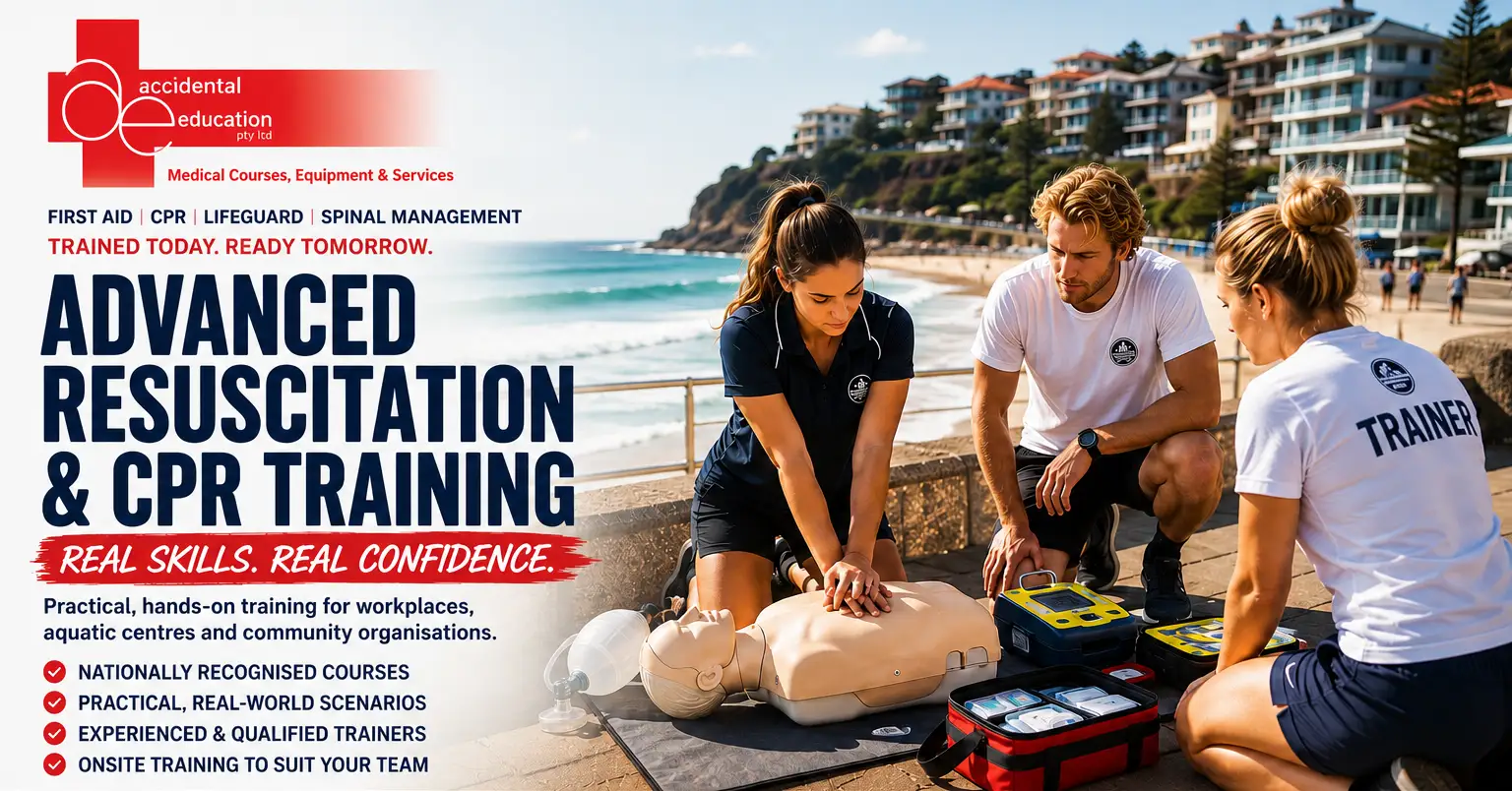
At Accidental Education, we specialise in practical emergency response training that prepares participants for real-world situations.
Our nationally recognised courses are delivered through our partnering Registered Training Organisation (RTO #40833) and include hands-on AED practice using professional training equipment.
We provide:
- CPR Training
- First Aid Training
- Workplace AED Training
- Advanced First Aid
- Advanced Resuscitation & Oxygen Therapy
- Pool Lifeguard Training
- Spinal Management
- Green Whistle (Methoxyflurane) Administration Training
- Annual Refresher Courses
We deliver flexible onsite training for businesses, councils, schools, healthcare providers, sporting clubs and aquatic facilities throughout New South Wales.
Final Thoughts
An Automated External Defibrillator is one of the most effective tools available for improving survival following sudden cardiac arrest. The sooner CPR is started and an AED is applied, the better the chances of a positive outcome.
Modern AEDs are designed to be simple, safe and effective. With quality training and regular practice, almost anyone can learn to use one confidently.
By understanding when and how to use an AED, you could one day make a life-saving difference for a colleague, family member, friend or complete stranger.
Would your workplace know how to respond to a cardiac arrest?
Accidental Education provides practical, nationally recognised CPR, First Aid and Workplace AED training throughout New South Wales.
Our experienced instructors deliver engaging onsite courses that build confidence and prepare your team to respond when every second counts.
📞 Call 0410 847 457
or
Contact us today to arrange workplace AED and CPR training tailored to your organisation.