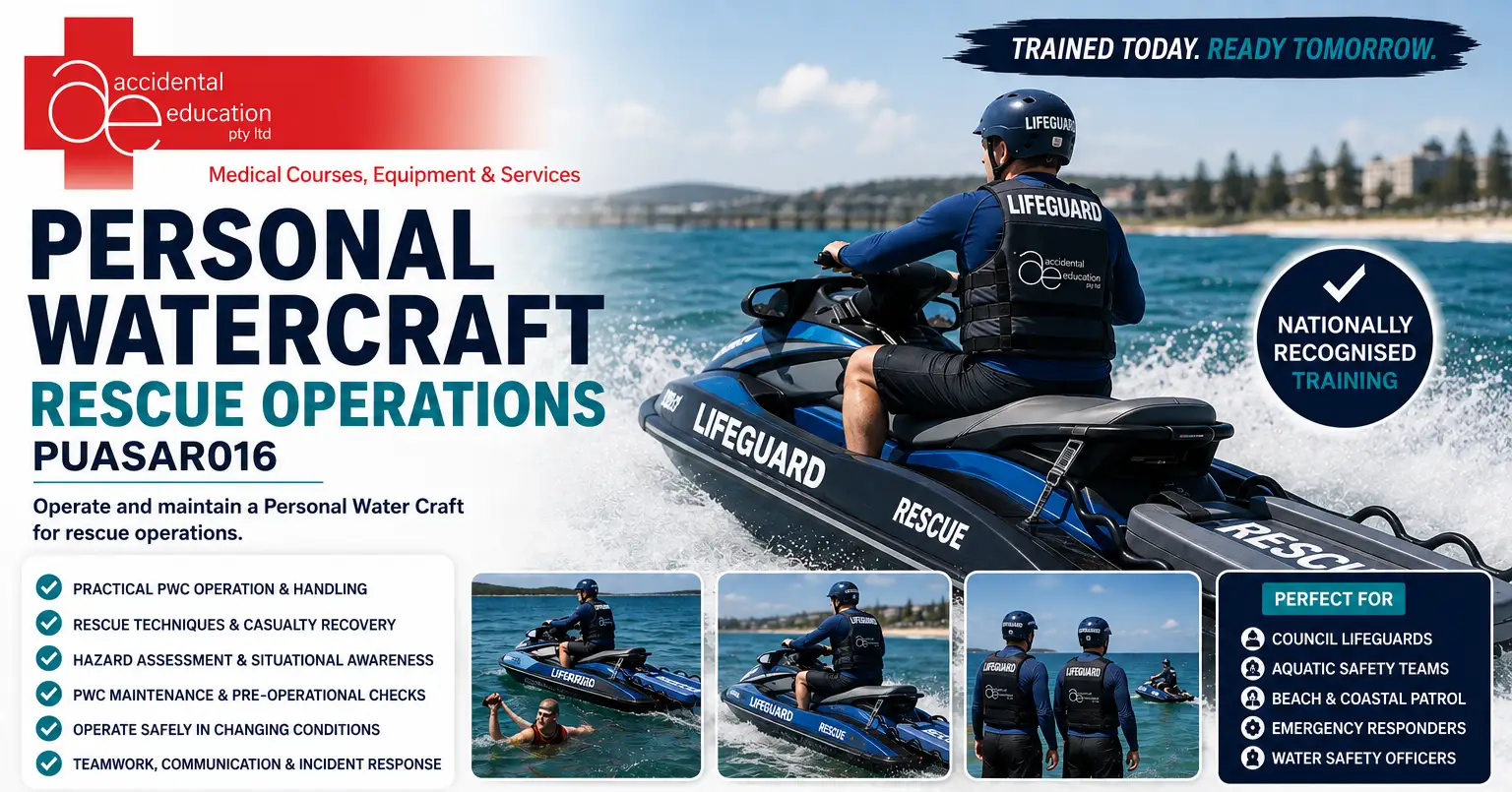
Personal Watercraft Rescue Operations Training NSW
Personal watercraft are an important operational tool for many aquatic rescue, beach safety and emergency response teams. When used correctly, a PWC can provide rapid access to incidents, assist with casualty recovery and allow trained personnel to respond effectively across coastal and aquatic environments.
PUASAR016 – Operate and Maintain a Personal Water Craft for Rescue Operations provides participants with the skills and knowledge required to operate and maintain a personal watercraft in rescue operations.
Accidental Education provides practical, operationally focused training for lifeguards, councils, aquatic safety personnel and rescue teams across New South Wales.
Our approach places an emphasis on real-world skills, safe PWC operation, rescue techniques, situational awareness and confident decision-making.
Trained Today. Ready Tomorrow.
What Is PUASAR016?
PUASAR016 is a nationally recognised unit of competency covering the operation and maintenance of a personal watercraft for rescue operations.
While recreational PWC operation focuses primarily on controlling the craft, rescue operations require a much broader skill set.
A rescue operator may need to control the watercraft while monitoring surf and water conditions, identifying hazards, communicating with other responders, approaching a casualty and assisting with recovery.
The operator must also understand the preparation, inspection and maintenance requirements necessary to keep the craft operationally ready.
This makes PUASAR016 particularly relevant for organisations that use personal watercraft as part of their aquatic rescue or emergency-response capability.
Who Should Complete PWC Rescue Training?
This training may be suitable for personnel whose operational duties involve the use of personal watercraft in aquatic environments.
Participants may include:
Specific eligibility, prerequisites, licensing and organisational requirements should be confirmed before enrolment.
What Will You Learn?
PUASAR016 develops the practical and operational skills required to prepare, operate and maintain a PWC for rescue activities.
Training and assessment may cover areas including:
Pre-Operational PWC Checks
Before entering the water, operators need to ensure the craft and associated rescue equipment are ready for use.
Participants develop an understanding of pre-operational inspections, safety procedures and equipment preparation.
Identifying a problem before deployment can prevent equipment failure during an actual rescue operation.
Personal Watercraft Handling
Effective PWC rescue operation requires much more than simply being able to accelerate and steer.
Participants develop practical watercraft control skills relevant to operational environments.
This can include manoeuvring, positioning, speed management and maintaining appropriate control around other personnel and casualties.
The objective is to develop a controlled and safety-focused operator, rather than simply a fast rider.
Hazard Identification and Risk Assessment
Aquatic environments can change rapidly.
Surf conditions, wind, currents, visibility, weather, submerged hazards, swimmers, other watercraft and changing beach conditions can all affect an operation.
PWC operators need to continually assess these factors and modify their approach accordingly.
PUASAR016 training develops situational awareness and reinforces the importance of making appropriate operational decisions before and during deployment.
PWC Rescue Techniques and Casualty Recovery
One of the most important differences between recreational riding and rescue operation is the requirement to safely approach and assist casualties.
Operators need to understand how their craft behaves around people in the water and how to position the PWC appropriately during rescue activities.
Depending on applicable training and assessment requirements, practical scenarios may include approaching casualties, assisting with recovery, positioning rescue equipment and supporting casualty transport.
The emphasis is on maintaining control while protecting the casualty, operator and other rescue personnel.
Teamwork and Communication
Aquatic rescue rarely occurs in isolation.
PWC operators may be working alongside lifeguards, beach patrol teams, aquatic personnel or other emergency responders.
Clear communication is therefore an important component of effective rescue operations.
Participants develop an understanding of operational communication, teamwork and coordinated response procedures.
These skills become particularly important when managing complex incidents or operating in changing environmental conditions.
Personal Watercraft Maintenance
A rescue PWC needs to be operational when it is required.
PUASAR016 therefore includes knowledge associated with the inspection and maintenance of the craft within the operator’s responsibilities.
Participants may develop knowledge around routine checks, identifying potential faults and maintaining operational readiness.
Maintenance must be undertaken according to manufacturer recommendations, workplace procedures and the operator’s level of responsibility.
A properly maintained PWC is not simply an equipment issue – it is an important part of rescue readiness and operational safety.
PWC Training for Council Lifeguards
PUASAR016 can be particularly valuable for councils responsible for beach and coastal safety.
Council lifeguards may patrol extensive beach areas where rapid response can make a significant difference during an aquatic emergency.
Personal watercraft can allow trained lifeguards to reach incidents quickly, support swimmers in difficulty and assist with coordinated rescue operations.
Accidental Education can work with councils and aquatic organisations to provide broader workforce training incorporating complementary competencies such as:
This allows organisations to build a more versatile and operationally prepared workforce.
Practical, Scenario-Based PWC Training
Operational rescue skills cannot be developed effectively through theory alone.
Accidental Education places a strong emphasis on practical, scenario-based training.
Where appropriate, participants apply their knowledge in realistic operational situations, helping them develop confidence in assessing conditions, controlling the PWC and making appropriate decisions.
The objective is to develop personnel who can apply their training when conditions are demanding and decisions need to be made quickly.
Practical Training. Operational Confidence.
Nationally Recognised Training
Participants who successfully meet all applicable training and assessment requirements may be eligible to receive the nationally recognised unit of competency:
PUASAR016 – Operate and Maintain a Personal Water Craft for Rescue Operations
Nationally recognised training and assessment is delivered through appropriate Registered Training Organisation (RTO #40833) arrangements.
Course prerequisites, licensing requirements, PPE, waterway requirements and other applicable conditions should be confirmed prior to enrolment.
PWC Rescue Training Across NSW
Accidental Education provides training solutions for organisations throughout Sydney, coastal NSW and regional New South Wales, subject to suitable training environments, equipment and course requirements.
Onsite and group training may be available for councils, aquatic organisations, lifeguard teams and other operational groups.
Our training can also form part of a broader aquatic safety program combining multiple competencies for an organisation’s workforce.
Why Choose Accidental Education?
We focus on training that prepares people for real operational environments.
Our PWC training complements our broader capabilities across lifeguarding, aquatic rescue, first aid and emergency-response education.
Participants benefit from a practical training approach focused on:
Whether you are developing individual competencies or training an entire aquatic safety team, our objective is to provide relevant skills that can be applied in the workplace.
Book Your PUASAR016 PWC Rescue Course
Prepare your personnel with practical personal watercraft skills designed for aquatic rescue environments.
PUASAR016 – Operate and Maintain a Personal Water Craft for Rescue Operations
Suitable for council lifeguards, aquatic rescue personnel, water safety teams and operational organisations across NSW.
Personal Watercraft Rescue Operations
Practical Skills. Rescue Ready. Operational Confidence.
Book Your Course Today
Onsite training available across New South Wales
Accidental Education – Trained Today. Ready Tomorrow.