Green Whistle (Methoxyflurane) Training NSW
PUAEME008 – Provide Pain Management
When an injury occurs, effective emergency care involves more than simply assessing the casualty. In appropriate circumstances, managing pain can also form an important part of the emergency response while further medical assistance is arranged.
PUAEME008 – Provide Pain Management is a nationally recognised unit of competency designed to provide eligible personnel with the skills and knowledge required to administer restricted analgesics in accordance with medically endorsed protocols.
One of the most recognisable pain-management devices used in Australian emergency and pre-hospital environments is the methoxyflurane inhaler, commonly known as the Green Whistle.
Accidental Education provides practical PUAEME008 pain-management training for eligible personnel and organisations throughout New South Wales, with a particular focus on lifeguards, councils, aquatic safety teams and emergency-response personnel.
Safe. Practical. Confident.
What Is PUAEME008 – Provide Pain Management?
PUAEME008 is the nationally recognised unit:
PUAEME008 – Provide Pain Management
The unit develops the skills and knowledge required to provide pain management within an emergency-care environment using approved analgesic interventions and appropriate procedures.
The training goes beyond simply learning how to assemble or use a Green Whistle.
Participants need to understand the entire process surrounding pain management, including casualty assessment, determining whether pain-management procedures are appropriate, identifying relevant precautions and contraindications, administering treatment according to authorised protocols, monitoring the casualty and providing appropriate follow-up care.
The objective is to develop responders who understand when, why and how pain management fits within a broader emergency response.
What Is the Green Whistle?
The Green Whistle is the commonly used name for a handheld inhaler associated with methoxyflurane, an analgesic used for short-term pain relief in certain emergency and pre-hospital situations.
The compact inhaler makes methoxyflurane particularly recognisable within Australian emergency-response environments.
However, methoxyflurane is a regulated medicine. Personnel must operate within applicable legislation, clinical governance arrangements, medically endorsed protocols, organisational procedures and their authorised scope of practice.
Completing PUAEME008 does not independently override those requirements.
Who Should Complete PUAEME008?
PUAEME008 may be relevant to eligible personnel whose operational responsibilities include responding to injuries where approved pain-management procedures may be required.
Participants may include:
Organisations should confirm eligibility, prerequisite requirements and authority to administer applicable analgesics before enrolment.
What Will You Learn?
PUAEME008 training develops practical skills in providing pain management as part of a structured emergency response.
Casualty Assessment
Effective pain management begins with an appropriate assessment.
Participants learn the importance of assessing the casualty, identifying injuries and recognising situations that may require urgent escalation.
Responders must remain focused on immediate threats to life while considering pain-management options within their authorised procedures.
Understanding Methoxyflurane
Participants develop knowledge of methoxyflurane and its role within emergency pain management.
Training can address:
Understanding these considerations is essential for appropriate decision-making.
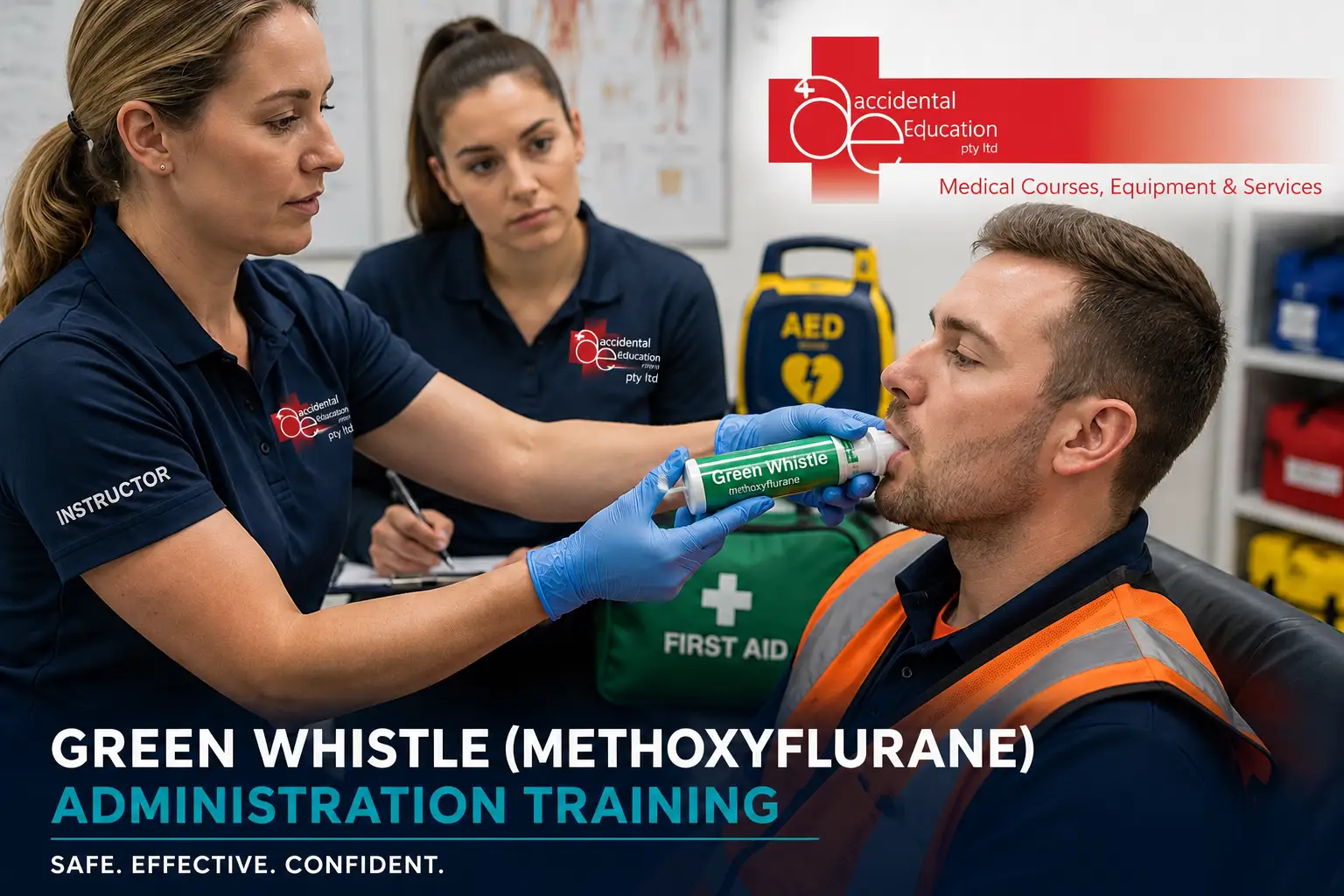
Practical Green Whistle Administration Training
Accidental Education places a strong emphasis on practical learning.
Participants can become familiar with applicable equipment and practise the procedures associated with pain management within a controlled training environment.
The aim is to develop a systematic approach.
Responders need to remain calm, communicate clearly with the casualty, follow approved procedures and continually reassess the situation.
A casualty experiencing significant pain may also be distressed or frightened. Effective communication can therefore be an important component of their overall care.
Monitoring and Ongoing Casualty Care
Administering an intervention is not the end of an emergency response.
The casualty must continue to be monitored.
Participants learn the importance of reassessment and recognising changes in the casualty’s condition.
Responders should also understand when additional medical assistance is required and how to provide an effective handover to paramedics or other healthcare professionals.
This reinforces an important principle of PUAEME008: pain management forms one component of comprehensive casualty care.
Green Whistle Training for Lifeguards
PUAEME008 can be particularly relevant to appropriately authorised professional lifeguards.
Beach and aquatic environments can expose personnel to incidents involving:
Where an organisation has appropriate clinical governance and medication procedures in place, trained personnel may be required to provide pain management while awaiting further medical assistance.
For council lifeguard teams, PUAEME008 can complement existing competencies in CPR, First Aid, Advanced Resuscitation, Spinal Management and Aquatic Rescue.
Practical Scenario-Based Training
Knowing a procedure in theory and performing it during a stressful emergency are very different experiences.
That’s why Accidental Education focuses on realistic, scenario-based learning.
Participants can practise casualty assessment, communication, equipment preparation, appropriate procedures, monitoring and teamwork.
Scenario training encourages participants to think about the complete emergency rather than focusing on one isolated skill.
Assess. Respond. Monitor. Communicate.
PUAEME008 Training for Councils
Local councils responsible for beaches, aquatic facilities, recreation services and operational teams may require personnel with a broad range of emergency-response capabilities.
Accidental Education can work with eligible organisations to provide practical training programs that support their operational requirements.
Related training may include:
PUAEME008 can become another component within this broader emergency-response framework.
Nationally Recognised PUAEME008 Training
Participants who successfully meet all applicable training and assessment requirements may be eligible to receive the nationally recognised unit of competency:
PUAEME008 – Provide Pain Management
Nationally recognised training and assessment must be delivered through appropriate Registered Training Organisation (RTO #40833) arrangements.
Applicable prerequisites, organisational authorisations, medication controls, clinical governance requirements and other conditions should be confirmed before enrolment and operational use.
Green Whistle Training Across NSW
Accidental Education provides training solutions across Sydney, Greater Sydney, coastal NSW and regional New South Wales, subject to course requirements and availability.
Onsite and group training may be particularly suitable for councils, lifeguard teams, aquatic organisations and emergency-response workplaces.
Our goal is to make specialist emergency training practical, relevant and directly applicable to the environments in which participants work.
Why Choose Accidental Education?
Our training is designed around a simple principle:
Prepare People for Real Emergencies.
We focus on:
Our broader emergency and aquatic training capability also means organisations can coordinate several complementary courses through a structured workforce training program.
Book Your PUAEME008 Green Whistle Course
Develop the knowledge and practical skills required to provide pain management within an appropriately authorised emergency-response environment.
PUAEME008 – Provide Pain Management
Featuring practical training relevant to Green Whistle (methoxyflurane) administration within applicable protocols.
Suitable for eligible lifeguards, councils, aquatic safety personnel, rescue teams and workplace emergency responders throughout NSW.
Safe. Effective. Confident.
Onsite and group training available across New South Wales.
Enquire About PUAEME008 Training Today
Call Accidental Education: 0410 847 457
Accidental Education – Trained Today. Ready Tomorrow.