ATV & Quad Bike Operational Training NSW – PUAVEH001
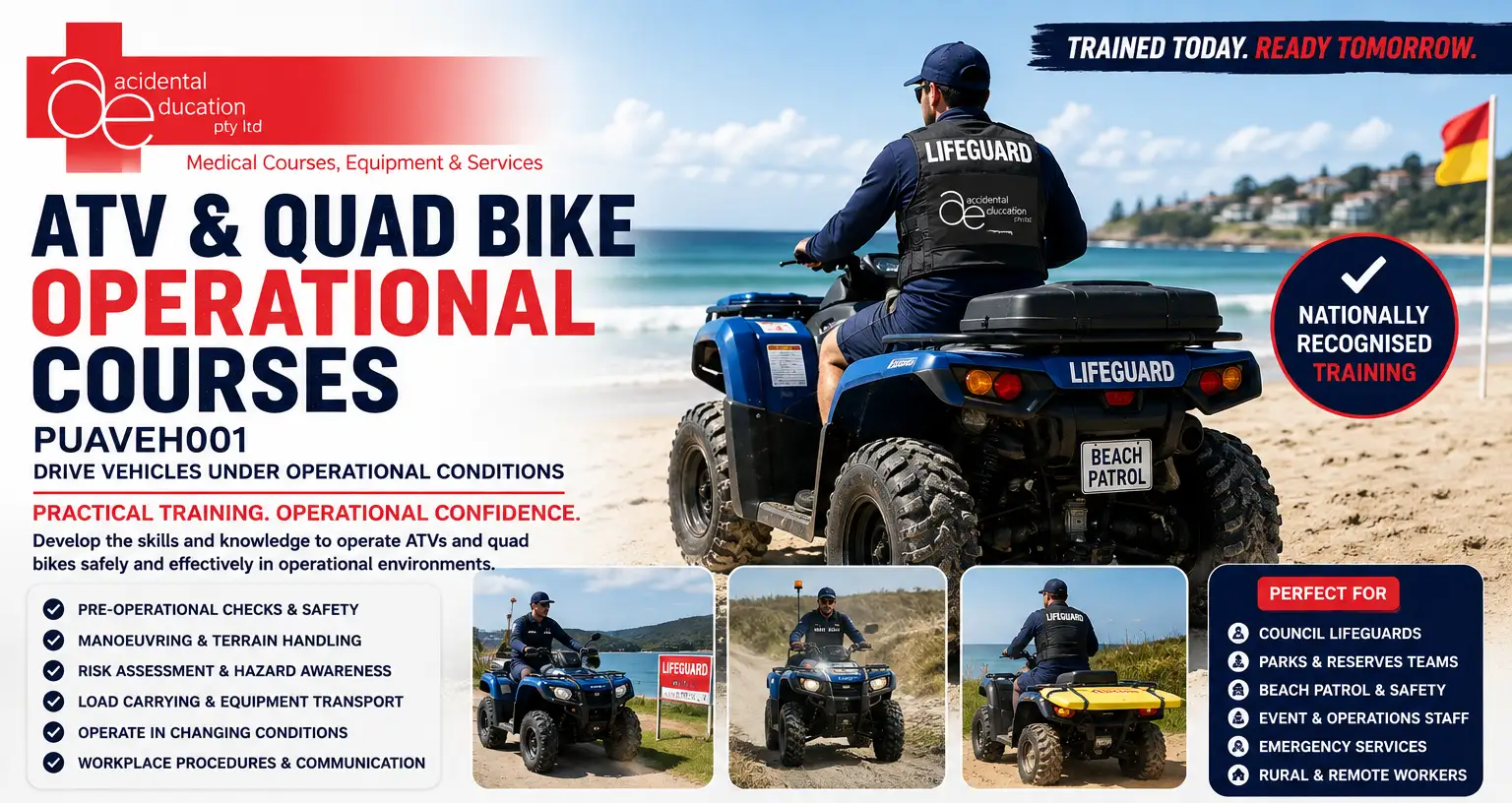
All-terrain vehicles and quad bikes can provide an important operational capability for lifeguards, councils, aquatic safety teams and emergency-response personnel working across beaches, reserves, parks and difficult terrain.
PUAVEH001 – Drive Vehicles Under Operational Conditions develops the skills and knowledge required to safely operate vehicles in operational environments where terrain, hazards and changing conditions can create additional challenges.
Accidental Education provides practical, scenario-based operational training for organisations and personnel across New South Wales.
For lifeguards and aquatic safety teams, ATV and quad bike skills can be particularly valuable when personnel need to patrol large beaches, transport equipment, access remote areas or respond quickly to an emergency.
Trained Today. Ready Tomorrow.
What Is PUAVEH001?
PUAVEH001 – Drive Vehicles Under Operational Conditions is a nationally recognised unit of competency designed for personnel who may be required to operate vehicles as part of their operational duties.
Operational driving can be significantly different from normal road driving.
Personnel may encounter sand, uneven surfaces, restricted access areas, steep terrain, environmental hazards and changing weather conditions while also being responsible for equipment, passengers or emergency-response duties.
The course focuses on developing the knowledge, judgement and practical vehicle-handling skills required to operate safely within these environments.
For organisations using ATVs or quad bikes as part of their operations, appropriate training can contribute to a safer and more capable workforce.
ATV Training for Lifeguards and Beach Safety Teams
ATVs are commonly used in environments where rapid movement across difficult terrain is important.
For professional lifeguards and beach safety teams, an ATV may assist with:
However, operating a vehicle on sand or uneven terrain introduces additional risks.
Drivers need to understand the limitations of the vehicle, assess the terrain and operate according to environmental conditions and organisational procedures.
PUAVEH001 training helps develop these operational skills.
What Will You Learn?
Training is designed to develop practical vehicle operation skills relevant to workplace and operational environments.
Depending on applicable course requirements, training and assessment may address areas such as:
Pre-Operational Vehicle Checks
Safe operations begin before the vehicle moves.
Participants learn the importance of conducting appropriate pre-operational inspections and identifying potential faults or safety issues.
This may include checking the vehicle’s general condition, tyres, controls, fuel, safety equipment and other relevant operational components.
Participants also develop an understanding of reporting faults and ensuring equipment is ready for operational use.
Assessing Terrain and Environmental Conditions
ATV operators must continually assess the environment in which they are working.
Conditions can change significantly between firm ground, soft sand, slopes, wet areas and uneven terrain.
Operators may also encounter pedestrians, beach users, vehicles, equipment and environmental obstacles.
Training develops awareness of these hazards and encourages participants to select an appropriate route and operating technique for the conditions.
The objective is not simply to reach the destination quickly.
It is to reach it safely and under control.
Practical ATV & Quad Bike Handling
Vehicle control is a major component of operational training.
Participants develop practical skills in controlling and manoeuvring the vehicle under conditions relevant to its intended operational use.
This may include appropriate acceleration, braking, steering, positioning and low-speed manoeuvring.
Operators also need to understand how changes in terrain can affect vehicle stability and handling.
Developing these skills helps participants become more confident while maintaining a strong focus on safe vehicle operation.
Managing Operational Risks
An ATV used during a beach patrol or emergency response is operating within a dynamic environment.
Operators may need to consider other staff, members of the public, environmental hazards, rescue equipment and changing conditions simultaneously.
Risk assessment therefore forms an important part of operational vehicle training.
Participants develop skills in identifying hazards, assessing risks and adapting their driving appropriately.
This approach helps build operators who make considered decisions rather than simply relying on vehicle-handling ability.
Transporting Equipment and Supporting Emergency Operations
ATVs and similar vehicles can provide an effective means of transporting operational equipment across areas that may be difficult to access using conventional vehicles.
For aquatic safety organisations, this may include transporting first aid equipment, rescue equipment, communications equipment or other operational resources.
Personnel need to understand that additional equipment can affect vehicle handling and must be transported according to applicable procedures and manufacturer requirements.
Effective operational driving therefore combines vehicle control, equipment management and situational awareness.
ATV Training for Councils
Councils may use ATVs and operational vehicles across a variety of environments, including beaches, reserves, parks and other public spaces.
Training may therefore be valuable for:
Accidental Education can work with councils and organisations to provide training appropriate to their workforce requirements and operational environments.
Group and onsite training options may also allow organisations to train multiple team members through a coordinated program.
Practical, Scenario-Based Training
Operational vehicle skills are best developed through practical application.
Accidental Education places an emphasis on hands-on and scenario-based learning wherever appropriate.
Participants have the opportunity to apply their knowledge to operational situations and develop their ability to assess conditions, identify hazards and select appropriate driving techniques.
The objective is to build confidence without encouraging unnecessary risk.
A competent operator understands both what the vehicle can do and, importantly, when conditions require a more conservative approach.
Practical Skills. Safer Operations. Confident Teams.
Nationally Recognised Training
Participants who successfully complete all required training and assessment may be eligible to receive the nationally recognised unit of competency:
PUAVEH001 – Drive Vehicles Under Operational Conditions
Nationally recognised training and assessment is delivered through appropriate Registered Training Organisation (RTO #40833) arrangements.
Specific prerequisites, licensing requirements, PPE, vehicle requirements and other enrolment conditions should be confirmed before undertaking the course.
Combine ATV Training With Aquatic Safety Courses
For councils and aquatic organisations, PUAVEH001 can form part of a broader workforce development program.
Accidental Education provides training across areas including:
Combining relevant competencies can help organisations develop personnel who are capable of responding across multiple aspects of aquatic safety and emergency operations.
ATV & Quad Bike Training Across NSW
Accidental Education provides operational training solutions for organisations across Sydney, metropolitan NSW, coastal NSW and regional New South Wales, subject to course, equipment and training-location requirements.
Onsite and group training may be available for councils, lifeguard teams, aquatic organisations and other operational workplaces.
Our focus is on practical education that reflects the environments in which participants may actually need to perform their duties.
Why Choose Accidental Education?
Accidental Education delivers training with an emphasis on practical capability, confidence and workplace relevance.
Our operational courses complement our specialist experience across first aid, lifeguarding, aquatic rescue and emergency-response training.
We focus on developing:
For organisations, this means training designed around skills that can be transferred into real operational environments.
Book Your PUAVEH001 ATV & Quad Bike Course
Build the practical skills and confidence required to operate vehicles safely in demanding operational environments.
Our experienced trainers provide engaging, hands-on learning that prepares participants to recognise cardiac arrest, perform effective CPR and use an AED safely and efficiently.
PUAVEH001 – Drive Vehicles Under Operational Conditions
Ideal for lifeguards, councils, aquatic safety teams, emergency-response personnel and operational organisations throughout NSW.
ATV & Quad Bike Operational Training
Prepare. Operate. Respond.
Onsite and group training available across New South Wales.
Book Your Training Today
Accidental Education – Trained Today. Ready Tomorrow.