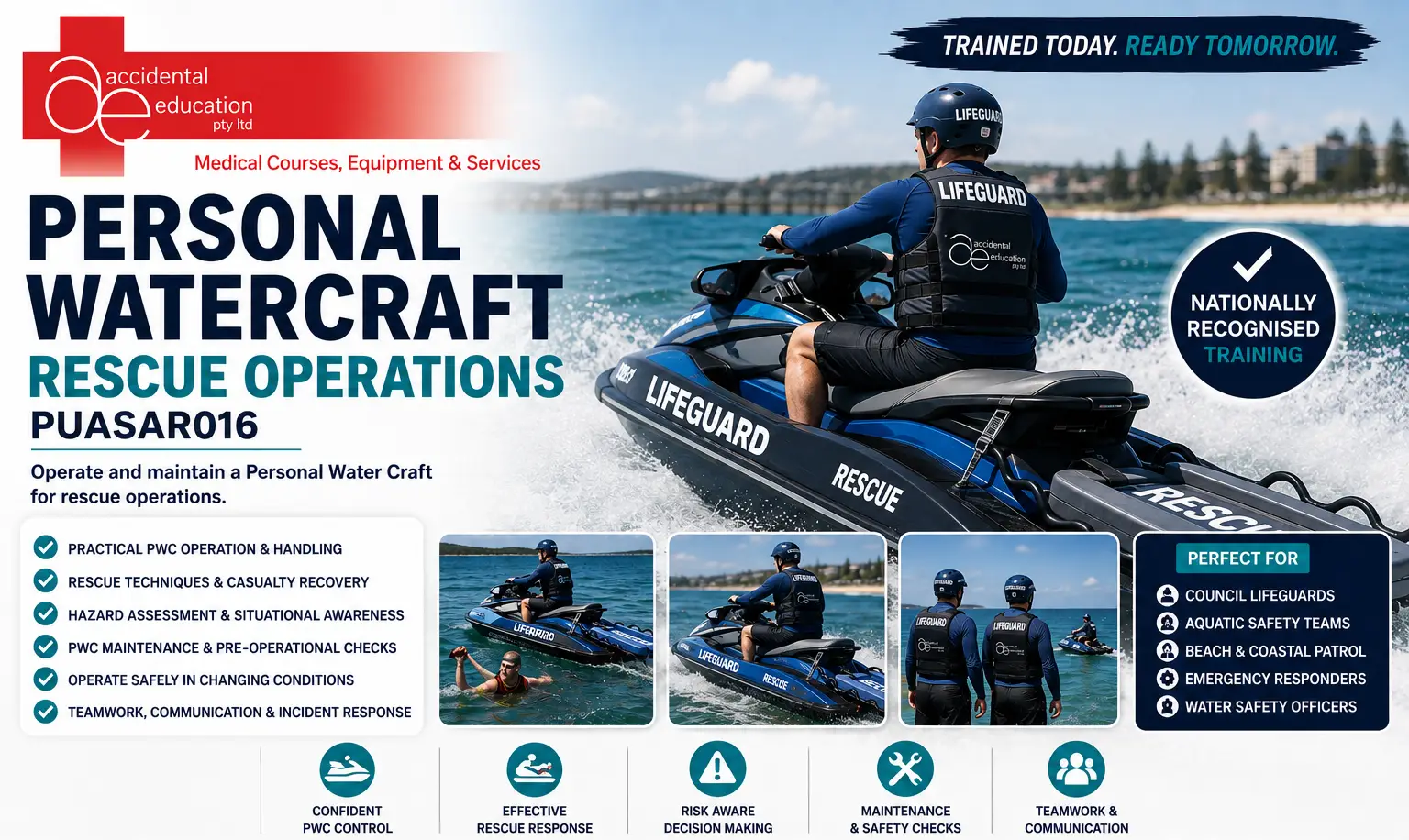
PUASAR016 – Operate and Maintain a Personal Water Craft for Rescue Operations
Personal watercraft can provide rescue personnel with rapid access to incidents in aquatic environments where time, mobility and effective decision-making are critical.
PUASAR016 – Operate and Maintain a Personal Water Craft for Rescue Operations develops the skills and knowledge required to safely operate and maintain a personal watercraft (PWC) when undertaking rescue operations.
Accidental Education provides practical aquatic and rescue training solutions for lifeguards, council personnel, aquatic safety teams and other operational organisations across New South Wales.
The course focuses on developing competent PWC operators who understand not only how to operate the craft, but how to apply their skills safely and effectively during rescue operations.
Practical Skills. Rescue Ready. Confident on the Water.
What Is PUASAR016?
PUASAR016 is a nationally recognised unit of competency focused on the operation and maintenance of a personal watercraft for rescue operations.
Operating a PWC recreationally and operating one as a rescue platform are very different responsibilities.
Rescue personnel must be capable of controlling the craft while simultaneously assessing environmental conditions, monitoring hazards, communicating with other responders and managing casualties.
Operators must also understand the preparation and maintenance requirements associated with keeping rescue equipment operational.
The course therefore combines practical watercraft operation with the knowledge and decision-making required in rescue environments.
Who Is This Course For?
PUASAR016 may be suitable for personnel who operate or may be required to operate personal watercraft as part of aquatic rescue or emergency-response duties.
Participants may include:
- Council beach lifeguards
- Professional lifeguards
- Aquatic rescue personnel
- Emergency-response personnel
- Water safety teams
- Beach patrol personnel
- Aquatic facility staff
- Coastal operations teams
- Rescue organisations
- Personnel working around waterways and aquatic environments
Entry, licensing, prerequisite and organisational requirements should be confirmed before enrolment.
Personal Watercraft Preparation
Effective rescue operations begin before the craft enters the water.
Operators need to understand how to prepare a personal watercraft for operational use and identify problems that could affect its reliability or safe operation.
Pre-operational procedures may include checking the craft, operational equipment and relevant rescue equipment before deployment.
Personnel also need to understand the importance of ensuring that the watercraft is appropriate and ready for the intended task.
A structured preparation process reduces the likelihood of preventable equipment problems occurring during an operation.
Safe Personal Watercraft Operation
Operating a PWC effectively requires practical control skills and a strong understanding of how the craft responds in different situations.
Training develops the participant’s ability to operate a personal watercraft appropriately while maintaining awareness of surrounding conditions.
This can include areas such as:
Craft control | Manoeuvring | Speed management | Positioning | Situational awareness | Hazard identification | Operational communication
Rather than focusing simply on speed, rescue operations require controlled, deliberate and appropriate watercraft handling.
The operator must remain capable of adapting to changing conditions while maintaining control of the craft.
Assessing Aquatic Conditions and Hazards
Aquatic environments can change rapidly.
Wind, waves, currents, visibility, other water users and environmental hazards can influence how a rescue operation should be conducted.
Operators must be capable of assessing conditions and determining an appropriate operational approach.
This is particularly important in coastal and open-water environments where conditions may vary considerably from one location to another.
Good PWC operation combines technical watercraft skills with sound judgement and continuous risk assessment.
Using a PWC During Rescue Operations
Personal watercraft can provide rescue teams with a highly mobile platform for accessing casualties and supporting aquatic rescue operations.
However, approaching and managing a casualty from a powered watercraft requires specialist skills.
Operators need to consider the safety of the casualty, themselves, other rescue personnel and surrounding water users.
Training develops the practical skills required to position and operate the craft appropriately during rescue scenarios while maintaining control and situational awareness.
Where relevant to the training and assessment requirements, participants can practise realistic scenarios designed to develop confidence under operational conditions.
Casualty Recovery and Transport
Recovering a person from the water is only one stage of an aquatic rescue.
Personnel may also need to assist with the casualty’s movement and transport while maintaining safety throughout the operation.
The operator needs to understand how the craft’s handling characteristics can change when carrying or supporting additional people or rescue equipment.
Practical training helps participants develop a coordinated approach to casualty management and transport.
Communication and teamwork are particularly important when multiple rescuers are involved.
Personal Watercraft Maintenance
Reliable rescue equipment must be appropriately maintained.
PUASAR016 includes the knowledge and skills associated with maintaining the personal watercraft in accordance with operational requirements.
Operators should understand routine checks and procedures that help identify potential issues and keep the craft ready for use.
Maintenance responsibilities must always be carried out within the operator’s level of authority and in accordance with manufacturer and organisational requirements.
The objective is to support a culture where rescue equipment is prepared, checked and operationally ready when required.
PWC Training for Council Beach Lifeguards
Personal watercraft training can be particularly relevant to councils responsible for beach and aquatic safety operations.
Council lifeguards may work across large coastal areas where rapid access to an incident is essential.
Accidental Education can work with councils to develop broader workforce training solutions incorporating complementary competencies such as:
Aquatic Rescue | CPR | First Aid | Advanced Resuscitation | Oxygen Therapy | Spinal Management | PWC Rescue Operations | Operational Vehicle Training
Combining related training can help councils develop more capable and versatile aquatic safety teams.
Practical, Scenario-Based Rescue Training
Rescue skills are best developed through realistic practical application.
Accidental Education places a strong emphasis on hands-on, scenario-based training that allows participants to apply knowledge under controlled operational conditions.
Participants can develop their ability to assess a situation, select an appropriate response and operate effectively as part of a rescue team.
This practical approach helps bridge the gap between knowing a procedure and being able to perform it confidently when required.
Onsite and Group Training Across NSW
Accidental Education provides training solutions for organisations across Sydney and regional New South Wales, subject to course, equipment, waterway and RTO requirements.
Group training may be suitable for councils, aquatic organisations, lifeguard teams and emergency-response personnel requiring a consistent level of operational competency across their workforce.
Where appropriate, training arrangements can be discussed around the operational requirements of the organisation.
Why Choose Accidental Education?
Our training philosophy is based on preparing participants for the environments in which they actually work.
For aquatic rescue personnel, that means combining technical competency with practical decision-making, communication, teamwork and situational awareness.
Trained Today. Ready Tomorrow.
Our broader training capability also allows organisations to develop integrated programs across first aid, CPR, advanced resuscitation, spinal management, aquatic rescue, lifeguarding and operational rescue skills.
PUASAR016 Certification
Participants who successfully meet all applicable training and assessment requirements may be eligible to receive the nationally recognised unit of competency:
PUASAR016 – Operate and Maintain a Personal Water Craft for Rescue Operations
Nationally recognised training and assessment must be delivered through appropriate Registered Training Organisation (RTO #40833) arrangements.
Applicable prerequisites, licensing, waterway rules, PPE, organisational procedures and regulatory requirements should be confirmed before course delivery.
Book Personal Watercraft Rescue Training
Develop the practical skills and operational confidence required to use personal watercraft effectively in aquatic rescue environments.
Accidental Education provides training solutions for lifeguards, councils, aquatic safety teams and operational personnel across NSW.
PUASAR016 – Operate and Maintain a Personal Water Craft for Rescue Operations
Prepare. Respond. Rescue.
Enquire about PWC Rescue Operations Training
Call Accidental Education: 0410 847 457