
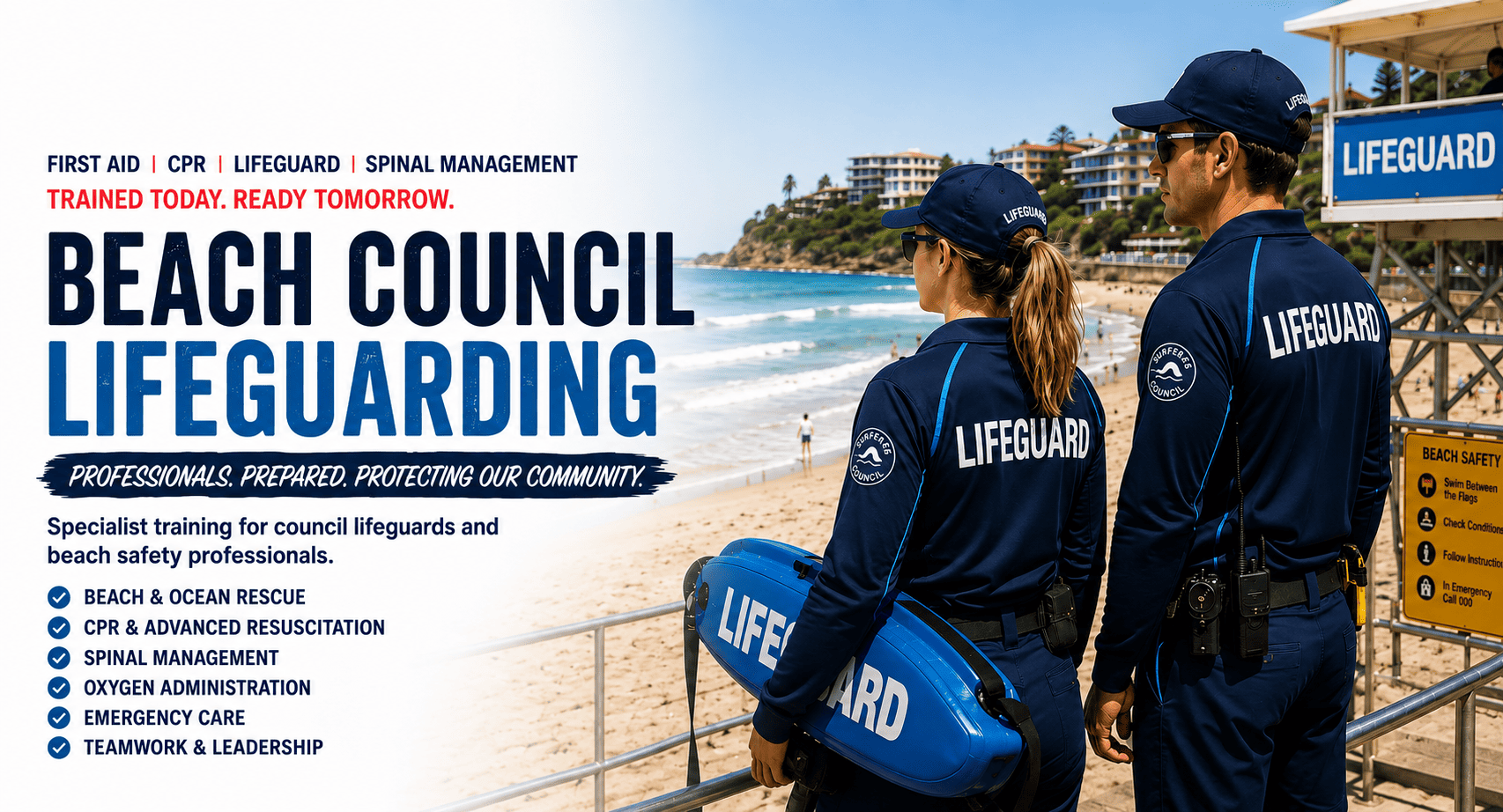
PUA20119 – Certificate II in Public Safety (Aquatic Rescue)
Professional aquatic rescue requires much more than being a confident swimmer.
Aquatic rescuers need to recognise people experiencing difficulty, assess changing water conditions, select appropriate rescue techniques, communicate effectively and work as part of a coordinated team during emergency situations.
PUA20119 – Certificate II in Public Safety (Aquatic Rescue) is a nationally recognised qualification designed for introductory-level participants undertaking aquatic rescue activities.
Accidental Education provides practical aquatic rescue training designed to prepare participants for the challenges of working around beaches, swimming pools, rivers, coastal environments and other aquatic locations.
Our training philosophy focuses on developing practical capability rather than simply completing a qualification.
Trained Today. Ready Tomorrow.
What Is PUA20119?
PUA20119 – Certificate II in Public Safety (Aquatic Rescue) provides participants with foundation skills for aquatic rescue operations.
The qualification develops the ability to recognise and rescue people experiencing difficulty in the water, use appropriate rescue equipment and communicate effectively during aquatic emergencies.
Aquatic rescue incidents can occur across many different environments.
These may include:
- Oceans and beaches
- Rivers and waterways
- Swimming pools
- Coastal environments
- Areas involving vessels
- Aquatic recreation locations
Participants develop practical skills that can contribute to patrol activities, lifesaving operations and organised aquatic emergency responses.
The qualification is particularly relevant to people beginning to develop professional or operational aquatic rescue capabilities.
Who Should Complete Certificate II in Public Safety – Aquatic Rescue?
PUA20119 may be suitable for people seeking foundation-level aquatic rescue skills or organisations developing the capabilities of their aquatic safety personnel.
This may include:
- Aspiring aquatic rescuers
- Lifeguards
- Beach safety personnel
- Council aquatic staff
- Aquatic centre employees
- Water safety personnel
- Rescue team members
- Coastal operations staff
- Recreation personnel
- People seeking a pathway into aquatic rescue roles
The National Training Register currently specifies no entry requirements for PUA20119. Individual training providers and employers may nevertheless have additional requirements relating to swimming ability, fitness, age, workplace duties or participation in practical activities.
What Will You Learn?
PUA20119 combines emergency response knowledge with practical aquatic rescue skills.
Participants develop capability across several important areas.
Surf Awareness and Self-Rescue
Understanding the aquatic environment is fundamental to safe rescue operations.
Participants develop awareness of surf and water conditions and learn self-rescue skills relevant to aquatic environments.
A rescuer who does not adequately understand environmental hazards can place both themselves and the casualty at additional risk.
Training therefore emphasises situational awareness and appropriate decision-making before entering a rescue situation.
Participating in Aquatic Rescue Operations
A central component of the qualification is developing the skills required to participate in aquatic rescue operations.
Participants learn to recognise when somebody may be experiencing difficulty and respond as part of an organised rescue operation.
Effective aquatic rescue requires responders to assess the situation, consider hazards and determine an appropriate course of action.
The objective is always to achieve a safe rescue while managing risks to the casualty, rescuer, team and surrounding public.
Emergency Life Support
Aquatic incidents can quickly become medical emergencies.
Participants develop basic emergency life-support capabilities so they are better prepared to provide immediate assistance following an aquatic rescue.
Emergency response may involve assessing the casualty, recognising life-threatening conditions and commencing appropriate care while additional medical assistance is arranged.
This connection between rescue and casualty care is an essential part of professional aquatic safety.
Communication During Aquatic Emergencies
Communication is critical during emergency operations.
Aquatic rescuers may need to communicate with other team members, supervisors, members of the public and external emergency services.
Participants develop workplace communication skills that can help support an organised and effective emergency response.
Clear communication becomes particularly important when several responders are performing different tasks simultaneously.
Working as Part of an Aquatic Rescue Team
Aquatic rescue is rarely an individual activity.
PUA20119 develops the ability to work effectively as part of a team and within a public safety environment.
Participants learn the importance of defined roles, communication, teamwork and following established operational procedures.
A coordinated team can manage complex incidents more effectively than responders acting independently.
Practical training helps reinforce these behaviours and allows participants to understand how their individual actions contribute to the wider emergency response.
Practical, Scenario-Based Aquatic Rescue Training
Aquatic rescue cannot be learned effectively through theory alone.
Accidental Education places a strong emphasis on hands-on, scenario-based training.
Participants can apply their knowledge to realistic aquatic situations, helping develop:
- Surf and water awareness
- Rescue techniques
- Hazard recognition
- Casualty assessment
- Emergency life support
- Communication
- Teamwork
- Decision-making
- Confidence under pressure
The goal is to prepare participants to apply their skills when confronted with a genuine aquatic emergency.
Qualification Structure
The current PUA20119 Certificate II in Public Safety (Aquatic Rescue) requires eight units of competency – six core units and two elective units.
The core units currently include:
HLTAID010 – Provide Basic Emergency Life Support
PUACOM001 – Communicate in the Workplace
PUASAR012 – Apply Surf Awareness and Self-Rescue Skills
PUASAR013 – Participate in an Aquatic Rescue Operation
PUATEA001 – Work in a Team
PUATEA004 – Work Effectively in a Public Safety Organisation
Two elective units are also required in accordance with the qualification’s packaging rules.
The elective structure allows training to be aligned more closely with relevant operational roles and organisational requirements.
Aquatic Rescue Training for Councils
PUA20119 can be particularly valuable for councils responsible for beaches, waterways and aquatic safety operations.
Accidental Education’s broader training capabilities allow organisations to develop comprehensive programs that can include:
Aquatic Rescue | Pool Lifeguarding | CPR | First Aid | Advanced Resuscitation | Oxygen Therapy | Spinal Management | PWC Rescue Operations | ATV & Quad Bike Operational Training | Pain Management
This provides councils with an opportunity to build teams with a broad range of practical emergency-response and aquatic safety capabilities.
Nationally Recognised Aquatic Rescue Qualification
Participants who successfully complete all required units and assessment requirements may be eligible to receive:
PUA20119 – Certificate II in Public Safety (Aquatic Rescue)
Nationally recognised training and assessment must be delivered through appropriate Registered Training Organisation (RTO #40833) arrangements.
The qualification is currently listed on the National Training Register and contains competencies designed for introductory-level aquatic rescuers.
Course delivery, elective selection and assessment arrangements should be confirmed prior to enrolment.
Aquatic Rescue Training Across NSW
Accidental Education provides training solutions for organisations throughout Sydney, Greater Sydney, coastal NSW and regional New South Wales, subject to course requirements, suitable aquatic environments and availability.
Training can be particularly relevant for:
Councils | Aquatic Organisations | Lifeguard Teams | Water Safety Personnel | Recreation Organisations | Public Safety Teams
Group training can also provide an effective way for organisations to develop consistent rescue procedures and teamwork across their workforce.
Why Choose Accidental Education?
Our training is designed around real operational capability.
We focus on developing:
Our specialist aquatic and emergency-response focus allows PUA20119 to integrate naturally with additional professional development across lifeguarding, first aid and rescue operations.
Practical Training. Confident Rescuers. Safer Communities.
Book Your PUA20119 Aquatic Rescue Course
Develop the foundation skills required to participate effectively in aquatic rescue operations.
PUA20119 – Certificate II in Public Safety (Aquatic Rescue)
Designed for introductory-level aquatic rescuers and suitable for organisations developing professional aquatic safety capabilities.
Prepare. Respond. Rescue.
Aquatic rescue training available across New South Wales, subject to course and facility requirements.
Enquire About PUA20119 Training Today
Call Accidental Education: 0410 847 457
Accidental Education – Trained Today. Ready Tomorrow.
For accuracy when this goes to the developer: PUA20119 requires 8 units — 6 core plus 2 electives. The official qualification currently lists electives including PUAVEH001 Drive Vehicles Under Operational Conditions, which could fit particularly well with the ATV training side of Accidental Education.